
Ilocos Sur Provincial Capitol
A columned landmark on Plaza Salcedo, the Ilocos Sur Provincial Capitol pairs early twentieth-century architecture with a memorial to Gabriela Silang.
Published · Last updated
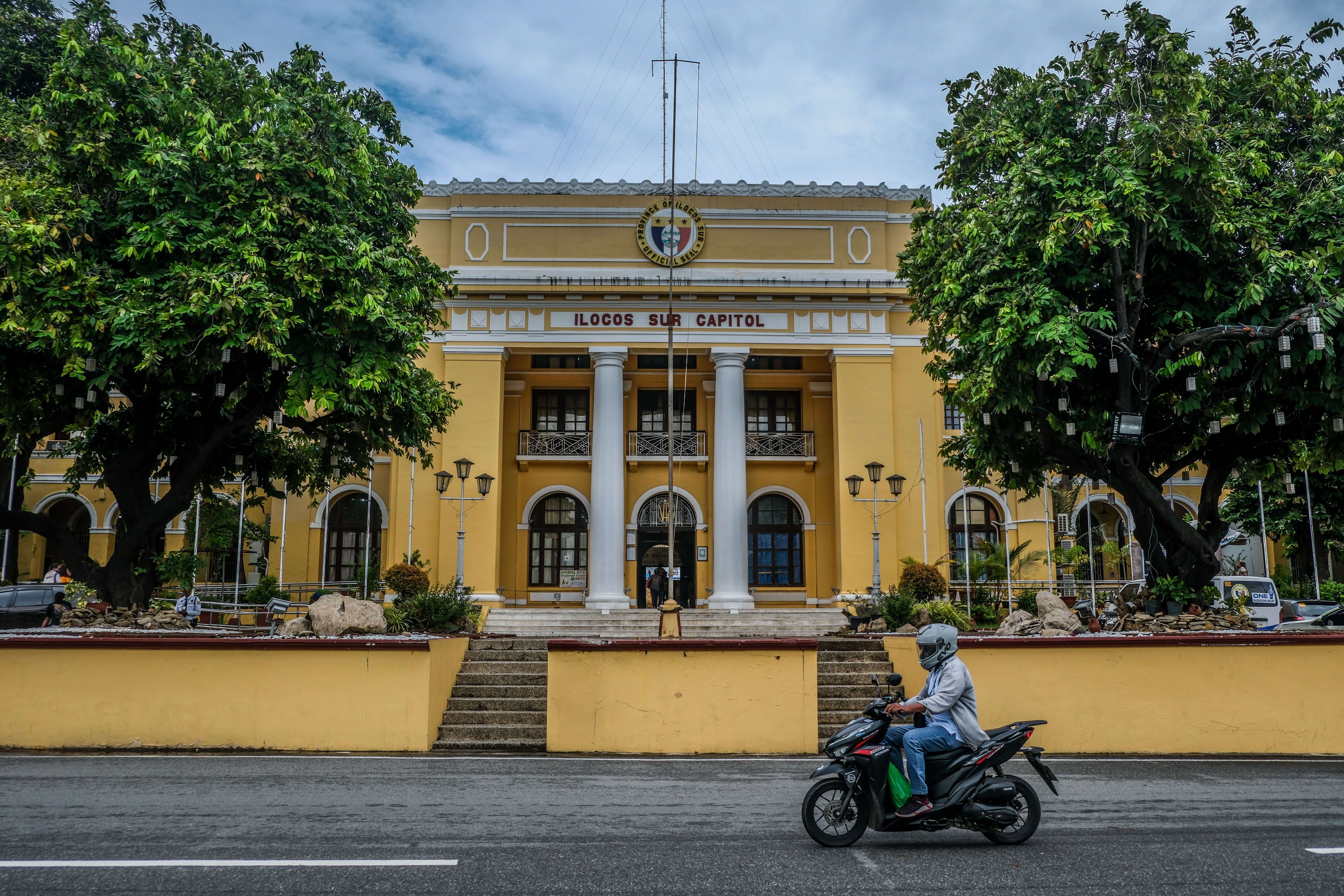
From Plaza Salcedo, look for the row of columns at the center of the capitol and the matching wings on either side. The building is the seat of the Ilocos Sur provincial government. At the corner of Quezon Avenue and Burgos Street, a historical marker tells another story tied to the square, where Gabriela Silang was executed in 1763.
Practical information
- Address
- Quezon Avenue and Burgos Street, Vigan City, Ilocos Sur
- Current use
- Seat of the Ilocos Sur provincial government.
- Architecture
- Early twentieth-century Palladian Revival, with a columned central block and matching wings.
- Historical marker
- A marker commemorating Gabriela Silang was installed in 1963.
- Public access
- View the exterior from Plaza Salcedo. Confirm interior access with the provincial government.
A later chapter in Vigan’s architecture
The capitol belongs to the early twentieth-century American colonial period, but the square it faces is older. Plaza Salcedo was laid out as part of Vigan’s Spanish colonial street grid. The cathedral, Archbishop’s Palace, City Hall, and capitol still cluster around the central plazas, where a short walk takes you between the seats of church, city, and provincial authority.
Step back across the plaza to see the whole frontage. The columns mark the entrance and give the central block more emphasis than either wing. From there, follow the two wings outward and notice how they balance each other. That strong center and symmetry are what make the building an example of Palladian Revival. Compare it with the nearby Archbishop’s Palace, where a long frontage and a steep roof give the building a different silhouette.
A provincial seat and its former jail
Ilocos Sur became a separate province in 1818, when the old province of Ilocos was divided into Ilocos Norte and Ilocos Sur. The split predates the present capitol by roughly a century. One nearby building helps put that timeline in perspective. Vigan’s town jail became the provincial jail in 1818 and continued to serve that role until 2014, when inmates were transferred to Bantay.
The former jail is now the Old Carcel Museum, part of the National Museum’s Ilocos Regional Complex. It makes a useful second stop after the capitol. The two buildings show different sides of provincial government, and the museum’s fourteen Basi Revolt paintings tell the story of a separate uprising in 1807.
Pause for Gabriela Silang’s story
The Philippines Historical Committee installed a marker to Gabriela Silang at the capitol in 1963. Look for it at Quezon Avenue and Burgos Street. Born in Barrio Canniogan in Santa, Ilocos Sur, she was adopted by Father Tomás Millán, grew up in Vigan, and married Diego Silang in 1757. Diego led the Ilocos Revolt of 1762–1763 against Spanish colonial rule, more than a century before the Philippine Revolution of 1896. He was assassinated in Vigan in May 1763.
Gabriela then took over the uprising. Spanish authorities captured her, and she was publicly executed at Plaza Salcedo on 20 September 1763. The capitol marker remembers her as the first woman to lead a revolt in the Philippines.
The marker and the plaza are two stops in the same story. Read the marker at the capitol corner, then look back across the square where her life ended, long before the present capitol was built.
Add it to a walk around the center
Pair the capitol with Plaza Salcedo, Vigan City Hall and the cathedral. The capitol serves the province, while City Hall serves Vigan. Their closeness makes it easy to compare the different buildings and the roles they’ve played in the city.
An exterior stop gives you plenty to appreciate. If you’d like to enter, check with the guards at the entrance about which areas are open to the public.
A closer look
Select a photo to view its caption and credit.
Related stories
SEE
Calle Crisologo
SEE