
History of Vigan
Before the postcard street, there was a landscape, a meeting place and generations of lives. Follow the threads of Vigan’s story, from before written records to a city still making history.
Draft — needs editing and fact-checking. Text and illustrations are provisional. Review before relying on or publishing this guide.
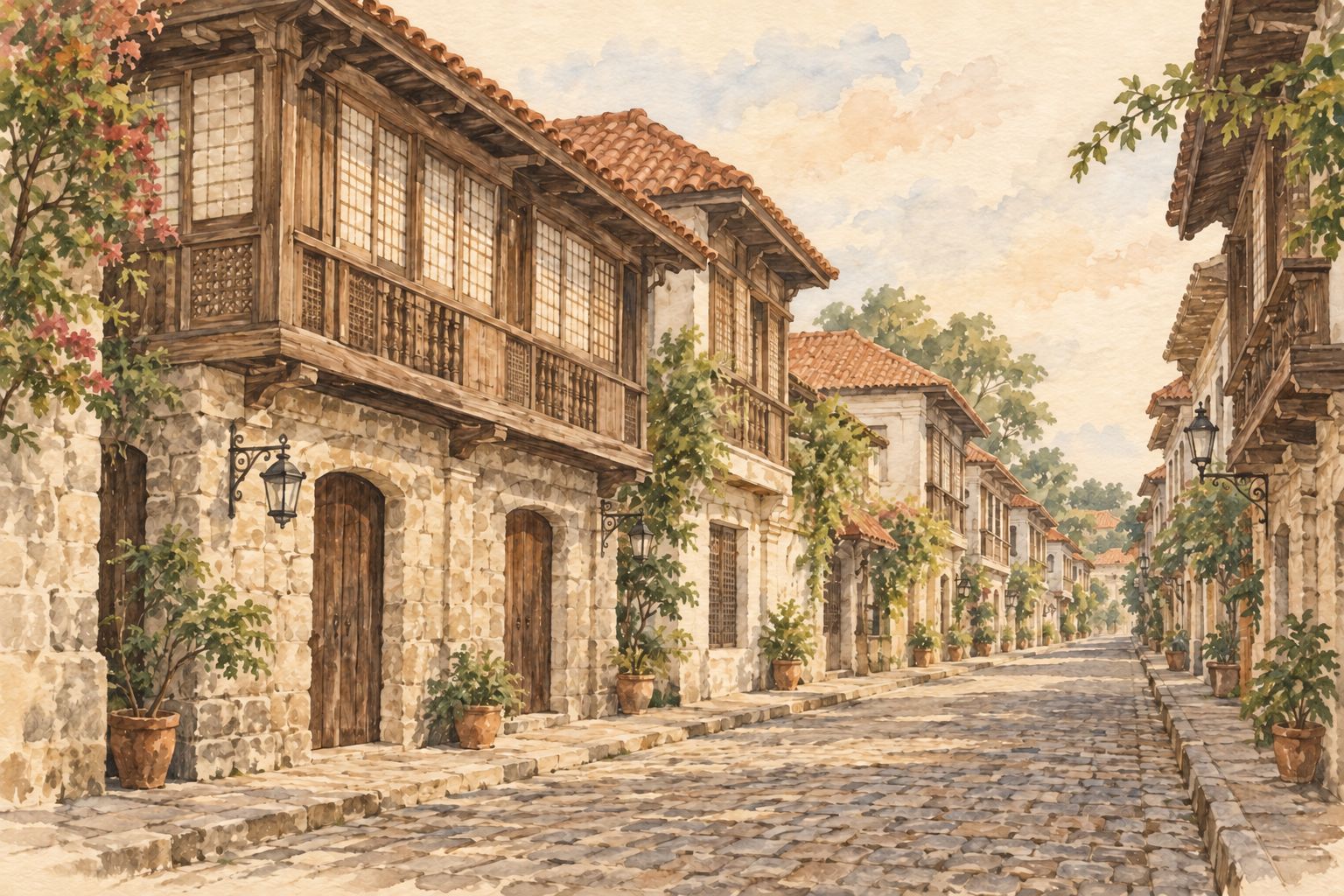
Before written records
A landscape before a city
Vigan’s story should begin before the colonial street plan. This opening chapter will explore the landscape and the earliest evidence of people living in the area.
Read more about A landscape before a city
A reliable local chronology needs archaeological evidence. Regional discoveries must not be presented as finds from Vigan itself. No settlement date is asserted in this draft.
Editorial reminder: Needs research and editing: obtain Vigan-specific archaeological references before adding dates, objects or settlement claims.
Link to this eraBefore 1572
A place of exchange
Before Spanish colonization, Vigan was a trading settlement. Its connections with other communities form an essential part of the city’s history.
Read more about A place of exchange
The city government’s account describes trade through the Mestizo River and the settlement of Chinese merchants. This chapter will explore how exchange shaped local life, without treating colonial arrival as the beginning of Vigan.
Editorial reminder: Needs fact-checking and editing: corroborate trade routes and distinguish documented history from naming legends.
Link to this era1572–1800s
The colonial town takes shape
The city government dates Juan de Salcedo’s arrival to 1572. Spanish administration introduced a new political order to an existing settlement.
Read more about The colonial town takes shape
Over the following centuries, Vigan’s streets and buildings took on the layered character still visible today. UNESCO describes a townscape shaped by Asian building traditions and European planning.
Editorial reminder: Needs fact-checking and editing: expand Indigenous perspectives and check the chronology of civic and religious buildings.
Link to this eraLate 1890s
Revolution and contested authority
The end of Spanish rule brought another period of conflict and political change. Vigan’s local history belongs within the wider struggles for Philippine independence.
Read more about Revolution and contested authority
The city’s historical account places revolutionary activity and subsequent American occupation in this period. A fuller account should include local participants, civilian experiences and independently checked dates.
Editorial reminder: Needs fact-checking and editing: compare the local account with archival and scholarly sources before adding a detailed sequence.
Link to this eraEarly 1900s–1941
Everyday life under a new administration
The American period introduces the next chapter: public institutions, education and the ways residents adapted to another colonial administration.
Read more about Everyday life under a new administration
This draft chapter sets the research scope. School records, family collections and local archives can help connect political history to everyday life without assuming that national developments occurred locally at the same time.
Editorial reminder: Needs research and editing: add sourced Vigan-specific milestones and photographs with documented dates.
Link to this era1940s–postwar years
War, survival and recovery
The Second World War and its aftermath are a necessary part of Vigan’s story. This chapter will consider occupation, civilian experience and recovery.
Read more about War, survival and recovery
Stories about the survival of the old town deserve careful sourcing. This draft does not treat popular accounts as settled fact; archival evidence and attributed testimony should guide the final narrative.
Editorial reminder: Needs research and editing: verify wartime dates and competing accounts with a local historian before publication.
Link to this era1999
Recognition of a shared heritage
The Historic City of Vigan was inscribed on the UNESCO World Heritage List in 1999, recognizing the significance of its historic townscape.
Read more about Recognition of a shared heritage
The designation concerns a living place, where conservation must coexist with residents’ homes and livelihoods. Follow the linked UNESCO record for the formal description and boundaries of the heritage property.
Editorial reminder: Needs editing: add a sourced account of the local conservation work that preceded inscription.
Link to this era2000s–present
A city still making history
The timeline ends in the present, with the people who live, work and care for Vigan. Heritage is also the daily practice of keeping a place useful and meaningful.
Read more about A city still making history
This chapter will be updated with verified developments in conservation, cultural life and the city’s response to change. It is an editorial outline, not a current-events report.
Editorial reminder: Needs research and editing: add recent, dated sources and verify the latest conservation and access conditions.
Link to this era